Autonomous Solutions
An autonomous surface vessel small enough to launch. Affordable enough to risk.
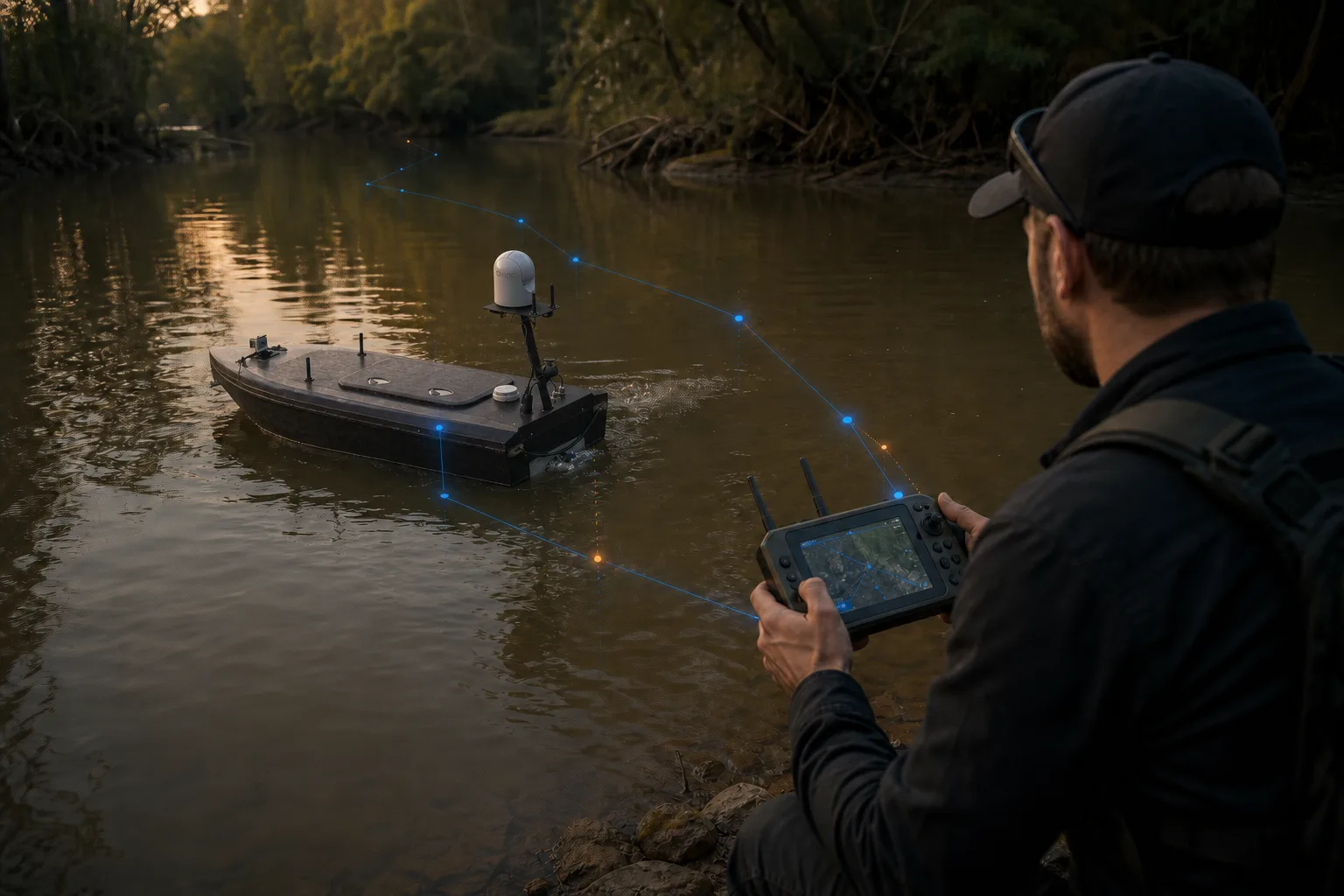
RiverScout is a man-portable autonomous surface vessel for brown-water surveillance and reconnaissance, small enough for a two-person launch and open enough to serve as an autonomy testbed.
RiverScout
RiverScout is a man-portable Autonomous Surface Vessel (ASV) built for brown-water surveillance and reconnaissance, run through a tactical robotic controller (TRC). It exists to put more eyes on the water without putting more people at risk: a low-cost, expendable asset that lets a command reduce risk by increasing the number of assets in play, not the number of operators.
See RiverScout in Action
A low-cost hull moving through brown water on its own, sensing, navigating, and reporting back, built to be risked on a mission a larger, more expensive asset wouldn't take.
Filmed during an actual operation, not a test-tank demo. This is what a two-person launch looks like in the field.
Our Mission
RiverScout isn't just a hull. It's a command-and-control package built on open standards, so it plugs into the systems an operator already runs instead of asking them to learn a new one.
Most Tactical USVs Need a Crane. This One Needs Two People.
The tactical end of the USV market runs long and heavy: thirty-plus feet, a trailer, a launch crew. RiverScout skips all of it. It goes in the water wherever the mission needs eyes, launched by the people already there, not staged days in advance by a logistics team.
Built to Be Tested, Not Just Fielded
RiverScout doubles as a payload and autonomy testbed for research and test and evaluation programs. It's cheap enough to risk on an experiment and open enough to carry a payload nobody's tried yet, which is exactly what a testbed is supposed to be.
RiverScout is one of several platforms in our Autonomous Solutions practice.
Missions
| Surveillance and reconnaissance | Eyes on water a crewed asset shouldn't be sent to. |
|---|---|
| Border and port security operations | Persistent coverage across approaches and harbor entrances. |
| Shipboard protection and surface warfare | A forward asset that keeps the crewed platform at distance. |
| Humanitarian assistance and disaster relief | Flooded ground and damaged waterways, surveyed without a crew. |
| Hydrographic studies | Survey work in shallow and constrained water. |
| Information collection | Sensor data off the water and back to the operator. |
Capabilities
| Environment | Brown and grey water operations. |
|---|---|
| Platform | Man-portable autonomous surface vessel, launched by two people. |
| Architecture | An agnostic platform, able to host camera integration, post-mission analysis and virtual testing. |
| Interfaces | Host software interfaces through IP radio to cameras, using the Joint Architecture for Unmanned Systems (JAUS). |
| Navigation | FalconView integration with dynamic waypoint tracking. |
The mission set and integration details are in the brochure below, written for the program offices and test directors who need the full picture before they need the demo.
Frequently Asked Questions
What is an autonomous surface vessel?
How many people does it take to launch RiverScout?
What does brown-water operation mean?
Does RiverScout work with existing control software?
Reach Out
Want to learn more about how RiverScout can serve your requirement? Ask about specifications, pricing, deployment timelines, or how RiverScout fits alongside the rest of our Autonomous Solutions practice, and we'll respond quickly.